



Featured Brands
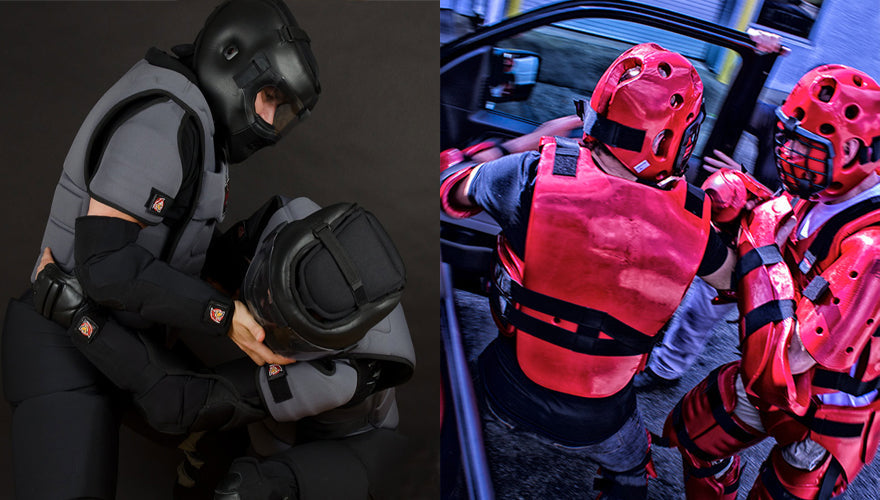

This article outlines key operational distinctions between Spartan Training Gear and RedMan for agency-level force-on-force training environments. The focus is not marketing differentiation, but structural integrity, injury mitigation, performance realism, durability, and long-term institutional value. These factors directly impact training safety, operational effectiveness, and long-term program sustainability within law enforcement environments. As force-on-force methodologies continue evolving toward higher realism and resistance-based scenario work, equipment architecture plays an increasingly significant role in both safety outcomes and training effectiveness.
RedMan systems rely primarily on traditional foam padding architectures developed around controlled instructor and impact-management training models. Spartan integrates reinforced structural zones and trauma plate architecture designed to disperse force across a broader surface area during close-contact engagements.
Operational Significance: Under full-resistance training conditions, traditional foam systems compress under load and can allow concentrated force transfer into critical anatomical areas. Structured force dispersion helps mitigate injury risk while supporting greater durability during repeated operational use.
RedMan helmet systems utilize traditional face cage configurations commonly associated with legacy padded training equipment. Spartan utilizes an Oakley Pro Aviator lens system with anti-fog and anti-scratch properties designed to maintain optical clarity during extended training rotations and elevated heat conditions.
Operational Significance: Visual degradation from fogging, scratching, or reduced clarity can directly impact safety, reaction time, communication, and decision-making under stress.
RedMan systems utilize a larger, heavily padded configuration designed primarily for blunt-force absorption during controlled striking and instructor-focused training evolutions where the role player remains relatively stationary. While this design prioritizes impact attenuation, the increased bulk and padding can restrict mobility, range of motion, transitional movement, and overall realism during dynamic engagements.
Spartan utilizes a lower-profile structural design that balances protection with mobility, allowing for natural movement patterns and unrestricted engagement during dynamic force-on-force training. The system is engineered to support movement-based training evolutions involving strikes, clinch work, takedowns, movement, and ground engagement without excessive bulk or restrictive padding.
Operational Significance: Excessive bulk and restrictive padding can limit realistic movement, transitional flow, and natural body mechanics during training. While heavily padded systems may be effective for stationary impact drills, dynamic training environments require participants to move, react, grapple, transition positions, and engage naturally under stress. Increased mobility and natural movement patterns help reduce training artificiality and better prepare students for unpredictable operational encounters.
RedMan systems prioritize maximum impact attenuation and instructor protection during repetitive striking evolutions. Spartan is calibrated to allow realistic impact recognition while still preventing injury, enabling immediate reset and continued training cycles.
Operational Significance: Excessive cushioning can unintentionally mask ineffective strikes or poor technique, creating false confidence in performance outcomes. Proper impact feedback supports accountability, measurable improvement, and more realistic performance evaluation.
RedMan represents a long-established legacy padded training platform widely adopted in academy and instructor-development environments. Spartan utilizes reinforced stitching, industrial-grade materials, modular construction methods, and replaceable component architecture engineered specifically for sustained agency-level training use.
Operational Significance: Enhanced structural durability reduces replacement frequency, lowers long-term equipment costs, and minimizes training interruption resulting from equipment degradation or failure. Modular component replacement also allows agencies to maintain operational readiness without replacing entire systems, improving long-term procurement value and lifecycle sustainability.
Spartan Training Gear is engineered for modern force-on-force environments where protection, mobility, realism, and durability must coexist. Its structural architecture, professional-grade optical system, calibrated impact feedback, and institutional-grade construction support injury mitigation, operational realism, and long-term lifecycle value for agency-level programs.
While legacy padded systems were developed primarily around controlled-contact instructor models, Spartan reflects a modern training platform built around mobility, resistance-based learning, and dynamic scenario realism.
______
Mark Joseph - Founder & CEO, Spartan Training Gear
Comments will be approved before showing up.